

Super Contribution Calculator
Work out your remaining concessional cap once your employer's contributions are counted, add any carry-forward, and see the tax it saves.
Built and checked byTimothy Hirou GaschereauFigures verified at the source on
Your details
Room left under your cap
$14,300
Your cap this year
$32,500
Already used
$18,200
Tax saved
$850
Contributing $5,000 saves you $850 in tax
Taken as salary it would be taxed at your marginal rate of 32%, costing $1,600. Inside super it is taxed at 15%, costing $750. The catch is that you cannot touch it until you are 60 and retired, which is either the point or the problem depending on your situation.
Your employer's super guarantee counts towards the concessional cap, which is the part most people miss. The tax saving compares your marginal rate against the contributions tax rate that applies to you, including Division 293 where relevant.
How to use this calculator
- 1. The calculator works out your employer's 12% super guarantee from it, which is the part of the cap you are using whether you meant to or not.
- 2. Salary sacrifice and any personal contribution you'll claim a deduction for both go here. They land in the same bucket as your employer's contributions.
- 3. ATO section, then Super, Information, Carry forward concessional contributions. It lists each of the last five years. Enter the total, and your super balance so the calculator can check you qualify.
- 4. It shows employer contributions first, then yours, then what's left. If the employer block is already most of the bar, your room is smaller than you think.
What actually counts towards the concessional cap
The cap is $32,500 for 2026-27, and three things fill it. Your employer's super guarantee at 12% of ordinary time earnings. Any salary sacrifice you arrange. And personal contributions you claim a deduction for, which require a notice of intent lodged with your fund before you lodge your return.
What does not count: after-tax contributions, the government co-contribution, and spouse contributions made into your fund. The trap sits at the top end. On a $200,000 salary your employer is already putting in $24,000, leaving about $8,500 of room. Past roughly $271,000 the guarantee fills the cap on its own, at which point extra concessional contributions stop being an option at all. Our guide to the concessional contributions cap covers the mechanics.
How carry-forward catch-up contributions work
If you have not used your full cap in past years, you may be able to contribute well above $32,500 this year. Two conditions: your total super balance was under $500,000 at 30 June last year, and the unused amounts come from the previous five financial years. Oldest year gets used first, and anything not used within five years expires permanently.
Say you left $8,000 unused in 2022-23, $10,000 in 2023-24, $12,000 in 2024-25 and $14,000 in 2025-26, with a balance of $320,000. Your cap this year becomes $32,500 plus $44,000, so $76,500. On a high marginal rate in a year with a capital gain or a bonus, that is one of the most powerful moves available in the system. Find your real numbers in myGov, and see carry-forward contributions for the timing rules.
What the tax saving actually is
Concessional contributions are taxed at 15% inside the fund instead of your marginal rate. The saving is the gap. Marginal rates below include the 2% Medicare levy, because that is what you actually pay on the salary you are giving up.
| Taxable income | Marginal rate | Saved per $1,000 |
|---|---|---|
| $18,201 to $45,000 | 15%, plus 2% levy once over $35,014 | $0 to $20 |
| $45,001 to $135,000 | 32% | $170 |
| $135,001 to $190,000 | 39% | $240 |
| Over $190,000 | 47% | $320 |
Notice the bottom row of that table. On an income in the 15% bracket, sacrificing into super saves you almost nothing in tax, and locks the money away for decades. That is the group the government co-contribution is aimed at instead. At the other end, once your income plus concessional contributions passes $250,000, Division 293 doubles the contributions tax to 30%, halving the saving to about $170 per $1,000. Still worth doing, just not the bargain it looks like.
What happens if you go over
Not a catastrophe, but it does undo the point. The excess gets added to your assessable income and taxed at your marginal rate, with a 15% offset for the contributions tax your fund already paid, so you are not taxed twice. An excess concessional contributions charge applies on top, calculated from the start of the income year.
The ATO issues a determination and you can elect to release up to 85% of the excess from your fund to pay the bill, with the remaining 15% staying put since that is the tax already paid. The practical defence is boring and effective: check your year-to-date contributions in your fund's member portal before making a large voluntary contribution in June, because timing is where most breaches come from.
After-tax contributions and the bring-forward rule
Non-concessional contributions come from money you have already paid tax on, so there is no contributions tax on the way in. The annual cap is $130,000 for 2026-27. Under 75, you may be able to bring forward up to three years at once, depending on your total super balance at 30 June 2026.
| Total super balance | Maximum contribution |
|---|---|
| Under $1.84 million | $390,000 over three years |
| $1.84m to under $1.97m | $260,000 over two years |
| $1.97m to under $2.1m | $130,000, no bring-forward |
| $2.1 million or more | Nil |
Bring-forward triggers automatically the moment you contribute more than $130,000 in a year, and once triggered you are locked into that period. Worth knowing before you make a large one-off contribution, because you cannot undo it.
The co-contribution and the spouse offset
If your total income is at or under $49,293 and you put in $1,000 of after-tax money, the government adds $500. That is a 50% return before the money has been invested in anything. It tapers by 3.333c per dollar of income above that and disappears at $64,293. You also need at least 10% of your income from work, to be under 71 at year end, and not to be on a temporary visa. No application, the ATO works it out from your return and pays it into your fund.
The spouse contribution offset works the other way. Contribute up to $3,000 to a spouse earning under $37,000 and you claim an 18% offset, worth up to $540, tapering out by $40,000 of their income. It builds their balance and cuts your tax at the same time, which makes it one of the few genuinely uncomplicated wins in super. Our guides to the government co-contribution and spouse contributions go through the eligibility properly.
FAQ
Does my employer's super count towards the cap?
Yes, and this is the thing people miss most often. The 12% super guarantee comes out of the same $32,500 cap as everything else. On a $200,000 salary that's $24,000 already used, leaving roughly $8,500 of room before carry-forward is considered.
What is the concessional cap for 2026-27?
$32,500. It covers employer super guarantee, salary sacrifice and personal contributions you claim a deduction for, all combined. Contributions inside the cap are taxed at 15% in your fund rather than at your marginal rate, which is the whole reason to use it.
How does carry-forward work and am I eligible?
Unused cap from the previous five financial years can be added to this year's, but only if your total super balance was under $500,000 at 30 June last year. Amounts are used oldest first, and anything more than five years old expires for good. Career breaks and part-time years are the classic reason people have room sitting there.
Where do I find my unused carry-forward amount?
In myGov, go to the ATO, then Super, then Information, then Carry forward concessional contributions. It lists each year separately. Do not estimate it, the ATO's figure is the one that counts and it accounts for contributions your employer reported that you may have forgotten.
How much tax does contributing actually save me?
The gap between your marginal rate and 15%. In the $45,001 to $135,000 bracket that's 32% against 15%, so about $170 saved per $1,000 contributed. In the top bracket it's around $320. In the lowest bracket it's close to nothing, which is worth knowing before you lock money away for decades.
What is Division 293 and does it apply to me?
An extra 15% on concessional contributions once your income plus those contributions passes $250,000, taking the effective rate to 30%. You still save against a 47% marginal rate, roughly $170 per $1,000 rather than $320. The ATO assesses it separately from your income tax and you can pay it from your super.
What happens if I exceed the concessional cap?
The excess is added to your assessable income and taxed at your marginal rate, with a 15% offset for the tax your fund already paid, plus an interest charge. You can elect to release up to 85% of the excess from super to pay it. It removes the benefit rather than creating a penalty, but the interest makes it worth avoiding.
Can I claim a deduction for personal super contributions?
Yes, but only if you lodge a notice of intent to claim with your fund and get it acknowledged before you lodge your tax return. Miss that step and the contribution stays non-concessional, which is a costly piece of paperwork to forget. Once accepted it counts towards the $32,500 cap.
What is the non-concessional cap?
$130,000 a year for 2026-27, from money you have already paid tax on, so there is no contributions tax when it goes in. If your total super balance is $2.1 million or more your cap is nil, and it steps down between $1.84 million and there.
How does the bring-forward rule work?
Under 75 with a total super balance below $1.84 million, you can use up to three years of non-concessional cap at once, so $390,000. Between $1.84m and $1.97m it drops to $260,000, and above $1.97m there is no bring-forward. It triggers automatically as soon as you go over $130,000 in a year, and you cannot untrigger it.
Am I eligible for the government co-contribution?
If your total income is under $64,293, you make an after-tax contribution, at least 10% of your income comes from work, you are under 71 at year end and not on a temporary visa. The maximum $500 applies at incomes up to $49,293 and tapers from there. It is the best return available to lower income earners, and it is automatic.
Should I contribute to my spouse's super?
If they earn under $37,000, contributing $3,000 gets you an 18% offset worth $540 and builds their balance at the same time. The offset tapers out by $40,000 of their income. For couples with a big income gap it also evens out balances, which matters later for the transfer balance cap and, if there is an age gap, for the Age Pension assets test.
Related reading

Non-Concessional Contributions: The Complete Australian Guide (2026-27)
Non-concessional (after-tax) super contributions in 2026-27: the $130,000 cap, the bring-forward rule, tax treatment, and what happens if you go over.

Superannuation for the Self-Employed: What You Need to Know
Why super isn't compulsory for sole traders, the real gap this creates, how the tax deduction works, and how to actually build the habit.

Super Co-Contribution: The Free Government Top-Up Most People Miss
How the super co-contribution actually works, the exact income thresholds, and why it's one of the most underused benefits in super.
Where these numbers come from
Every rate and threshold in this calculator was read off the official page, not copied from another calculator. Check them yourself, they change.
📚 Recommended reading
Super Made Simple
Noel Whittaker
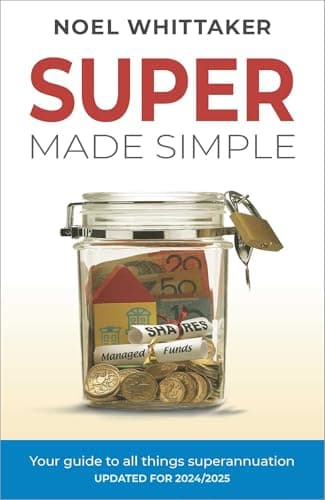
Super Made Simple
A focused, up-to-date guide to actually understanding your superannuation, from one of Australia's most trusted finance writers.
The Barefoot Investor
Scott Pape

The Barefoot Investor
Australia's best-selling money book ever. A simple system for accounts, budgeting, debt and a real emergency fund in one.
Some links above are affiliate links. If you buy through them, Snowball Invest may earn a small commission at no extra cost to you. We only recommend books we'd suggest anyway.
SnowLetter
Australia's money news and our best reads, once a week.
Disclaimer
This calculator uses 2026-27 Australian figures: a $32,500 concessional contributions cap, a $130,000 non-concessional cap, the 12% super guarantee, a $250,000 Division 293 threshold, a $500,000 total super balance test for carry-forward, and government co-contribution thresholds of $49,293 and $64,293. It estimates your employer contributions from the salary you enter, so if your employer pays above the guarantee or your ordinary time earnings differ from your salary, enter the real figure. It does not model the bring-forward rule's interaction with your total super balance in detail, the spouse contribution offset, downsizer or first home super saver contributions, defined benefit funds, or contributions made after age 67 where the work test may apply. Caps and thresholds are set by the government and change each financial year. This tool provides estimates only and is not financial, tax or legal advice. Confirm current figures at ato.gov.au or speak with a licensed financial adviser.